Extremist Cultures Online
INTS1302 NAVIGATING DIGITAL WORLDS, WEEK 6
Assessment 1 due Friday
THE TUTORIAL IS YOUR WORKING SESSION
- Assessment 1 is due Friday 4 September.
- This week’s tutorial is a working session for it.
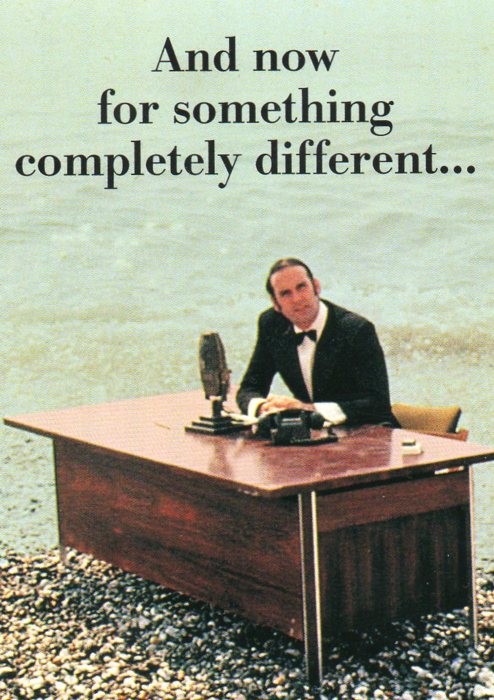
And now for something completely different
Content Warning
CRITICAL ANALYSIS, NOT ENDORSEMENT
Content Warning. The content of this report necessarily engages with themes that are extreme and anti-social. Examples of extreme, hateful, and violent language are included in order to faithfully reproduce the data collected.
Some racial and religious slurs as well as an obscenity have been redacted.
Support is available
SERVICES YOU CAN CONTACT DURING OR AFTER THIS LECTURE
- You can step out at any time, or ask me to pause or skip material.
- 1800 CARE MQ (1800 2273 67) connects you with support anytime, any day.
- Lifeline is available any time on 13 11 14.
students.mq.edu.au → Support → Wellbeing Counselling and Wellbeing, and the confidential CARE Form self-referral.
One investigation at every scale
FROM SINGLE POSTS TO POPULATION CLAIMS, AND WHAT EACH STEP CAN SHOW
- In 2020 we mapped online right-wing extremism in New South Wales for the state government.
- One government question became evidence, findings, recommendations, and what government did next.
- Evidence lives at many scales, from a single post to whole platforms.
- A claim’s scale must fit the scale and construction of its evidence.
- A corpus is the whole collection of posts gathered for one analysis, and corpora is its plural.
posts → conversations → accounts → networks → corpora → platform landscapes → the population (beyond this evidence)
March 2019, Christchurch
AN ATTACK MEDIATED ONLINE, BY AN ATTACKER FROM NEW SOUTH WALES
- In March 2019 a terrorist murdered 51 people at mosques in Christchurch, New Zealand.
- The attack was streamed and shared online, and the attacker came from New South Wales.
- The New South Wales Government needed to understand its own online extremist environment.
The commission
A MAPPING STUDY BY A TEAM INCLUDING YOUR LECTURER
- The Department of Communities and Justice commissioned a mapping study in 2019.
- We delivered it, academics from Macquarie University and Victoria University.
- We studied communities we opposed, which raises the standard for careful description.
Three research questions
WHAT THE METHODS MUST BE ABLE TO ANSWER
- Three broad questions: the environment’s nature, its narratives, its risk.
- The methods that follow must be able to answer them.
- What is the nature of the online RWE environment in NSW?
- How are themes and narratives framed in different online contexts in order to mobilise support?
- What level of risk does the online RWE environment pose?
The Gab corpus
FROM SEED ACCOUNTS TO A CONNECTED MILIEU
- Gab is a small social platform with minimal moderation, popular with the far right.
- I started from supplied seed accounts and followed reciprocal connections outward.
- Snowball sampling finds a connected community, not a population.
- The Gab collection found users interested in Australia rather than Australian users.
The Twitter corpus
17,000 POSSIBLE ACCOUNTS, 27 CHOSEN
- On Twitter, 17,000 possible accounts were too expensive to collect.
- We hand-picked 27 accounts and I collected the conversations around them.
- A separate purchase of 300,000 Australian tweets narrowed to 37,442 from users naming a New South Wales location.
- Cost, selection and self-reported location all shape what the sample can show.
Too big to read
1.36 MILLION POSTS AND THE TURN TO DISTANT READING
- The Gab collection alone holds 1.36 million posts from 23,836 accounts.
- No one can read that many posts one by one.
- Distant reading uses computation to find patterns across an entire corpus.
- Franco Moretti coined the term for studying literature at scale.
Reading the pattern
THE PLOT SHOWS WHEN TERMS MOVE, NOT WHAT THEY MEANT
- Each row is a term. Each mark is a moment it appeared in the corpus.
- A spike shows that a term moved. It cannot say what users meant.
- We went back to the conversations to interpret each pattern.
- Analysis moves both ways between the aggregate and the particular.

What each sample can say
TWO CONSTRUCTIONS, TWO DIFFERENT CLAIMS, NO POPULATION ESTIMATE
- The Gab sample shows a connected milieu around chosen seeds.
- The Twitter sample shows selected public conversations from self-identified locations.
- Neither is a random sample, so neither can say how common extremism is in New South Wales.
What we found
PLATFORM ENVIRONMENTS, SHARED CONTENT, MODERATION, TWO LEVELS OF RISK
- Platforms sit on a spectrum from low to high risk, set by echo-chamber strength and moderation.
- Different platforms drew on different sources of shared content.
- Two levels of risk: a creeping shift in acceptable discourse, and individuals advocating violence.
- Some findings come straight from the corpora; others rest on published research the report cites.
Sociable and hateful at once
FAIR DESCRIPTION DOES NOT REQUIRE NEUTRALITY
- These communities are genuinely social spaces with shared values and real debate.
- The same spaces are hateful, anti-democratic and risky.
- Fair description reports both truthfully. Neutrality is not required.
Four things the evidence cannot show
INTENT, READERSHIP, PREVALENCE, AND CAUSE
- Posts alone cannot separate irony and bragging from real capability and intent.
- Collected accounts cannot show who silently reads.
- Constructed samples cannot estimate how widespread these views are.
- Observed association cannot prove a path to changed belief or violence.
The intelligence product
RESEARCH BUILT TO PERSUADE ONE SPECIFIC CLIENT
- The report is an intelligence product written for one client, the New South Wales Government.
- It connects questions, evidence, findings, limits and possible action in one argument.
- Its job is to be usable by a reader who must decide something.
What did we recommend?
FIVE AREAS FOR POLICY, AND WHO COULD ACT ON EACH
- Four research priorities and five areas for policy consideration close the report.
- A useful recommendation names who could act, what could change and who is affected.
- The report’s own areas vary in how explicitly they do this.
- “Awareness raising for key stakeholders across different levels of government and civil society about the revolutionary and anti-social agenda of right-wing extremism.”
- “Building awareness about the civic underpinnings of representative liberal democracy and the threat that right-wing extremism poses.”
- “Expanding current CVE infrastructure provided by the NSW government to individuals and communities vulnerable to right-wing extremism.”
- “Right-wing extremism exists across urban, regional, and rural NSW, with local government being well positioned to deliver programs in some communities.”
- “Upskilling front-line workers to recognise the risks associated with right-wing extremism; and providing pathways into CVE intervention programs for individuals identified as being at-risk.”
What happened next
EVIDENCE GIVEN, LANGUAGE CARRIED, NO DIRECT POLICY CHANGE
- The client commissioned further mapping work.
- Team members gave evidence to a New South Wales inquiry and a federal inquiry.
- A parliamentary committee repeatedly cited a submission that drew its description of the problem from our report.
- No chamber mention and no numbered finding directly cited the report.
Why write reports nobody acts on?
SHAPING WHAT GOVERNMENT CAN SAY AND SEE
- Influence can be indirect: language, framing and evidence travel without credit.
- The research network carried the report’s description into the submission and committee material.
- An intelligence product can matter even when no one acts on it immediately.
What distance cannot show
ACTIVITY, READERSHIP, AND THE LIMITS OF A CONNECTED SAMPLE
- Collected conversations measure activity, not everything a community does.
- Reading without posting leaves no trace in the data.
- A connected sample describes the network we followed, not the state we live in.
The whole investigation
CLAIMS SIZED TO THE EVIDENCE THAT CARRIES THEM
- Close reading interprets particular posts and conversations. Distant reading finds patterns across whole corpora.
- The analysis climbed between them, and each move changed what could be claimed.
- Policy answers needed both: patterns to see the environment, close reading to say what the patterns meant.
- A claim’s scale must fit the scale and construction of its evidence.
posts → conversations → accounts → networks → corpora → platform landscapes → the population (beyond this evidence)
The shitposting milieu
WEEK 4’S SOCIAL STEGANOGRAPHY, AT COMMUNITY SCALE
- These communities speak in irony, in-jokes and provocation, a style often called shitposting.
- Week 4 called this social steganography: insiders read the signal, outsiders cannot settle the meaning.
- That is one reason posts alone cannot reveal intent.
References
Ballsun-Stanton, B., Waldek, L., Droogan, J., Smith, D., Iqbal, M., & Peucker, M. (2020). Mapping Networks and Narratives of Online Right-Wing Extremists in New South Wales (Version 1.0.1). Macquarie University. https://doi.org/10.5281/zenodo.4071472
Moretti, F. (2000). Conjectures on world literature. New Left Review, 2(1), 54–68. https://doi.org/10.64590/hxj
Royal Commission of Inquiry into the Terrorist Attack on Christchurch Mosques on 15 March 2019. (2020, December 8). 2. The terrorist attack. https://christchurchattack.royalcommission.nz/the-report/part-1-purpose-and-process/the-terrorist-attack
AI Use Disclosure
- Claude (Anthropic) and Codex (OpenAI) produced more than 1.2 million output tokens between 22 and 30 August.
- More than half of the output came from human-steered main threads.
- Two machines measured the work and their counts partly overlap.
- The tools supported source research, planning, drafting, production and verification.
- Brian selected the argument, sources and teaching form.