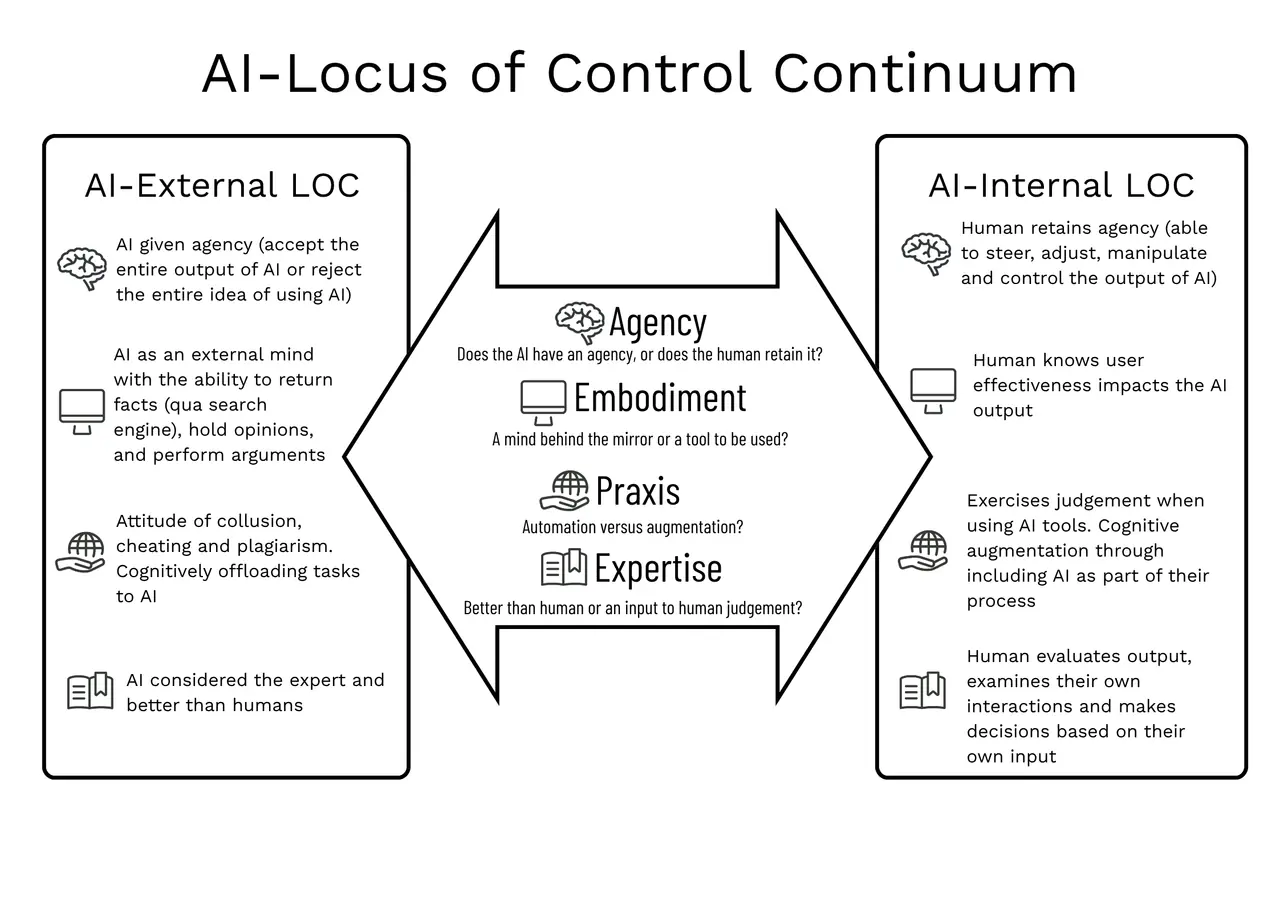
AI-Locus of Control asks who directs the outcome when a person works with AI: the person or the tool.
Locus of control is a person’s belief about whether outcomes depend on their own actions or on forces outside their control. AI-Locus of Control (AI-LOC) applies that question to work with AI: who directs the outcome, the person or the tool?
Our first study followed 12 students through one semester in a self-selected, experimental university unit. In this qualitative case study, students increasingly described and demonstrated themselves as directing the tool rather than simply accepting its output. Read the study.
The four dimensions
Each dimension has two poles, internal and external. At the internal pole, control or authority rests with the person, and at the external pole it rests with the AI, with luck, or with something outside them. Neither pole is better than the other, because a pole says where a person places control, not how well they work. Handing a whole task to AI can be a deliberate and efficient choice.
AI-Locus of Control Continuum, 2026 version. Brian Ballsun-Stanton and Jodie Torrington, Zenodo, doi:10.5281/zenodo.17823627, CC BY 4.0.
Agency
Do I reach for the tool, and who drives the outcome?
Internal
The person places control of the outcome with themselves. They say that they drive the result, rather than luck or the AI, or they say they decide when and whether to bring AI in.
External
The person credits the outcome to the AI’s own tendencies and limits, to chance, or to circumstance, without their own steering entering the account. That can be resignation, and it can equally be an accurate reading of a tool whose output varies, or a deliberate choice to delegate.
Embodiment
What is the tool, and how do I engage it?
Internal
The person treats the AI as a tool that works on what they feed it and does what they specify. Its output is a product of their instructions, not of any understanding it has of them.
External
The person treats the AI as an entity in its own right. It has perspectives, ideas, or an understanding of them, and interacting with it is like dealing with another mind.
Praxis
What happens to the output?
Internal
The person works the AI’s output into something of their own. They treat it as a starting point to refine, keep responsibility for what they put out, or decline it and do the work themselves.
External
The person adopts the AI’s output as delivered. They hand it on largely as received, rely on it for work they do not fully grasp, or delegate the production wholesale.
Expertise
Was it any good, and whose judgement decides?
Internal
The person holds their own knowledge, judgement, or taste as the standard, and checks the output against it. That standard need not be factual, so noticing that writing is flat or a design is clumsy counts.
External
The person holds the AI’s knowledge above their own and consults it as the authority. When the two differ they expect the AI to be right, and deferring to a more capable source can be a reasoned stance.
Adapted from the AI-Locus of Control codebook by Brian Ballsun-Stanton, Jodie Torrington and Ellie Meissner, published as Supplement S5 of the Stage 1 preprint under CC BY 4.0.
Current study
We have deposited the Stage 1 study plan for a longitudinal study of AI-LOC in higher education. The study asks whether students come to direct AI rather than defer to it, and whether existing measures can answer that question or a purpose-built AI-LOC measure is needed. Read the registered study plan.
Our proposed AI-Locus of Control framework has emerged from our recent longitudinal study on the impact of explicit teaching about AI literacy on students' agency and control beliefs in human-AI interactions (https://osf.io/preprints/edarxiv/6mke5_v3). From our analysis, we identified four key dimensions or tensions in AI-Locus of Control:
AGENCY: Does the AI have agency, or does the human retain it? Students with external LOC felt they had to either accept AI output or reject the entire idea of using AI. Students with internal LOC realised they could steer, adjust, and control output on a sentence-by-sentence basis.
EXPERTISE: Is AI better than human, or an input to human judgement? Some students initially treated AI as an expert that couldn't be questioned. Through the unit, they learned that their own prompting and setup was crucial to producing output they felt comfortable claiming as their own.
EMBODIMENT: Is there a mind behind the mirror, or is it a tool to be used? Early in the semester, students engaged with AI as if there was an intelligence behind it. By the end, they understood they held sole responsibility for populating the context window with facts and scaffolding.
PRAXIS: Automation versus augmentation? Some students used AI to automate their assignments entirely. Others learned to dip in and out, using it for partial ideation, sense-checking, and editing - augmenting rather than automating their process.
These four tensions give us a richer understanding of what AI-LOC means in practice.
The study measures whether students' beliefs and orientation about AI shifts across a semester of teaching. This orientation, a student's AI-Locus of Control, is whether they direct the AI tool or defer to it. The design is longitudinal, mixed-methods, and Bayesian. It runs across three cohorts at one university. Both surveys are collected and sealed, and no response has been examined. This deposit lets a reviewer inspect the parts of the analysis plan fixed before the data are seen: the survey instrument, the qualitative codebook, the design simulations that set the evidence thresholds, and the record of how AI assisted the work. The survey responses are not here. They are sealed now and embargoed to Stage 2.
Background: As AI disrupts education systems worldwide, there is an urgent need for students to develop AI literacy while maintaining human agency. While extensive research has examined self-efficacy in technology contexts, there is a notable gap in understanding how locus of control (LOC) specifically applies to human-AI interactions in educational settings. LOC is defined as the belief that outcomes are contingent on one's own behaviour versus external forces. Objectives: This study examined how explicit instruction and guided practice with multiple frontier Large Language Models (LLMs) impact students' agency and control beliefs in human-AI interactions. Methods: A longitudinal qualitative case study followed 12 undergraduate students through a semester-long experimental AI unit. Data collected through surveys, focus group discussions, and weekly observations were analysed thematically, using LOC theory as an interpretive framework. Results and Conclusions: Students demonstrated a clear progression toward internal AI-LOC, developing critical awareness and agency in their AI interactions. The findings revealed that sustained, scaffolded AI instruction enabled students to view themselves, rather than the technology, as the primary driver of outcomes. This study contributes to AI literacy theory by demonstrating that locus of control, rather than self-efficacy, may be the critical construct for understanding human agency in AI interactions, introducing the concept of AI-LOC as a new theoretical framework for education research.
This dataset contains educational materials from an AI-focused course, including: - Student assessments from AI History, AI Philosophy, and AI Politics streams - Class transcripts from various sessions - Course materials, schedules, and rubrics